
Carbon Capture & Sequestration
What is Carbon Capture and Sequestration?
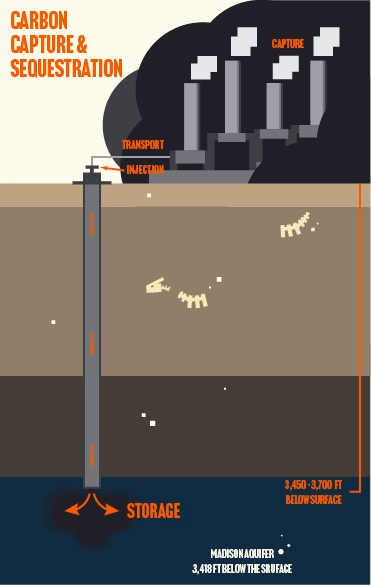
Carbon capture and sequestration (CCS) is a process by which carbon dioxide (CO2) is captured from industrial processes, transported (usually via pipeline), and then stored underground. While touted as a beneficial way to store industrial waste, CCS threatens people’s health and livelihoods, devastates the environment, and actually fails to capture carbon in an impactful way. Beyond that, it is also expensive, receiving billions of dollars in government subsidies, while providing no substantial jobs or profits for local
economies.
Carbon capture and sequestration impacts all of us by wasting money, destroying vital ecosystems, and ensuring that big corporations continue to win by exploiting our communities.


Phase 1: We stopped Exxon in Carbon County Montana!
People power stops CCS project in Eastern Montana
Following years of community organizing by our member leaders in Carter County, we are thrilled to announce that ExxonMobil withdrew from the Snowy River Project in July 2026.
This effort was led by Northern Plains Resource Council and Save the Range, a group founded by Northern Plains members impacted by the project. Together, we’ve organized and mobilized hundreds of concerned citizens in Carter County and around the state. Our members were quick to respond to this threat, citing concerns around the potential for groundwater contamination, harm to native rangeland and wildlife, impacts on grazing leases and county roads, and public safety.
“This is an encouraging outcome for Montana. We’re grateful to everyone who took the time to get informed, ask questions, and make their voices heard,” said Northern Plains member leader Steve Summers. “The lesson here isn’t about one project, it’s about what engaged citizens can accomplish. The public process only works when the public shows up, and when they do they become plan makers instead of plan takers. While this is an important milestone, it isn’t the end of the story, and we’ll continue to stay engaged.”
“This isn’t just the end of a project. It’s proof that courage is contagious, community is powerful, and when people refuse to stay silent, history can change. This victory sends a powerful message: never underestimate a rural community that refuses to be intimidated. When people stand together, even the biggest challenges can be overcome.”

Liz Barbour
Member Leader,
Hammond
Read More
Nearly one year ago, the BLM announced that they would not be approving Denbury’s full request, citing public concerns over the project. Instead, they approved limited surface access to a test well in Carter County for the company to use to confirm the geologic viability of their project.
‘We’ve heard the public’s concerns, and we’re acting on them,” said BLM Montana/Dakotas State Director Sonya Germann in a press release on July 31, 2025. “This decision allows for critical data gathering without advancing the full project at this time. It’s a step that ensures transparency and continued dialogue.”
This choice was a direct result of the community’s robust attendance at local BLM meetings and the overwhelming response to the request for public comment, both of which were enhanced by local organizing led by local people.
Following the right of way approval, Denbury would have also needed authorization from the Montana Board of Oil and Gas Conservation to use the well for testing. Residents waited on bated breath for Denbury to pursue this application and begin testing, but that never happened. Instead, Denbury withdrew their application with the BLM to access the approved test well, essentially reversing the project back to zero.
“This isn’t just the end of a project. It’s proof that courage is contagious, community is powerful, and when people refuse to stay silent, history can change,” said Northern Plains member leader Liz Barbour. “This victory sends a powerful message: never underestimate a rural community that refuses to be intimidated. When people stand together, even the biggest challenges can be overcome.”
Following years of community organizing by our member leaders in Carter County, we are thrilled to announce that ExxonMobil withdrew from the Snowy River Project in July 2026.
This effort was led by Northern Plains Resource Council and Save the Range, a group founded by Northern Plains members impacted by the project. Together, we’ve organized and mobilized hundreds of concerned citizens in Carter County and around the state. Our members were quick to respond to this threat, citing concerns around the potential for groundwater contamination, harm to native rangeland and wildlife, impacts on grazing leases and county roads, and public safety.
“This is an encouraging outcome for Montana. We’re grateful to everyone who took the time to get informed, ask questions, and make their voices heard,” said Northern Plains member leader Steve Summers. “The lesson here isn’t about one project, it’s about what engaged citizens can accomplish. The public process only works when the public shows up, and when they do they become plan makers instead of plan takers. While this is an important milestone, it isn’t the end of the story, and we’ll continue to stay engaged.”
“The lesson here isn’t about one project, it’s about what engaged citizens can accomplish. The public process only works when the public shows up, and when they do they become plan makers instead of plan takers. While this is an important milestone, it isn’t the end of the story, and we’ll continue to stay engaged.”

Steve Summers
Member Leader

What was the Snowy River Carbon Dioxide Sequestration Project?
CCS wants to come to Montana?
The Snowy River Carbon Dioxide (CO2) Sequestration Project was a proposal from Denbury Carbon Solutions, LLC, a subsidiary of ExxonMobil. If completed, it would lead to the industrial development of native rangeland. The project would capture carbon dioxide emissions from Wyoming natural gas plants and inject them into the ground near Ekalaka over the next 20 years.
“Wait, wouldn’t that help us fight greenhouse gas emissions?”
Great question! Carbon capture and sequestration (CCS) was presented as a solution to climate change, but unfortunately, it’s all smoke and mirrors. Over the lifespan of the project, it is estimated that some 150 million tons of CO2 will be pumped into the ground in Carter County. From an air quality standpoint, that sounds impactful, but in just 2 years (2022 and 2023), Exxon operations alone produced 188 million tons of CO2. CCS projects are too expensive, risky, and ineffective to be seen as real solutions. They harm communities and environments while allowing corporations like Exxon to expand operations. It is still unclear what immediate and long-term effects this amount of pollution will have on the local ecosystem and groundwater, which serves as the primary source of water for ranchers and residents in the area.
What are the Big Problems that Carbon Capture and Sequestration creates?
Land & Water Impacts
Denbury’s 15 proposed wells would have been located on BLM and state-managed land and consist of 500 acres of surface area disturbance, including roads, pipelines, and pump stations. Denbury also applied for 100,200 acres of federally managed pore space to inject a projected 150 million tons of CO2 over 20 years. The scope of the project has raised concerns over impacts to water supplies, grazing leases, county roads, and law enforcement requirements..
Expensive
Carbon capture and sequestration projects are infamously expensive. According to the 2023 report by the Congressional Budget Office, the cost to implement CCS projects often “exceeds its value in most potential settings.” To get these projects off the ground, they receive billions of dollars in government subsidies, while providing no substantial jobs or profits for local economies.
Ineffective
Several of the world’s largest CCS projects have underperformed with some capturing only half the amount that was promised. Including ExxonMobil’s LaBarge facility in Wyoming, which has underperformed by 36%.
Carbon Dioxide (CO2) Leakage
There have been concerns about possible future carbon dioxide (CO2) leakage into the atmosphere. One $2.7 billion CCS project in Algeria had to be suspended in 2011 due to concerns about the storage integrity of the trapped CO2 underground. There are also several examples of other gas storage failures. The worst of these being the California Aliso Canyon gas leak in 2015, in which 97,000 metric tons of methane leaked into the atmosphere.
“This project isn’t for Montana. It creates no real jobs. It puts no money into our community. Every resident pays the price, landowners and non-landowners alike, while our land, water, health, and way of life are put at risk.”
Liz Barbour
Member Leader,
Hammond

Jack Owen
Member Leader,
Ekalaka
“We love our way of life. We love how we’ve shared this part of the world here. We’re happy with the responsibility of passing it to the next generation and we want to leave them with the same opportunities that we had in this part of the world. We can go out and enjoy the silence, watch the little fingernail moon turn into a full moon and back again.
GET INVOLVED
Carbon Capture & Sequestration is expensive, risky, and ineffective
Building a large network of teams who share the same goal will help us show up to the next state legislative session with the people power we need to make sure our interests our put above those of wealthy corporations.
If you want to join a team of people in your community who are pushing their local government for data center regulations, click the button below and let us know! Click below to join a local team or become a team captain!
